 Steel
Key facts
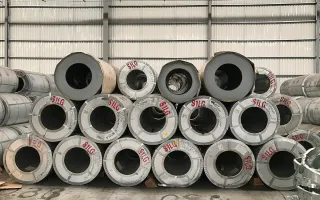
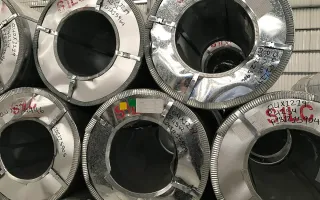
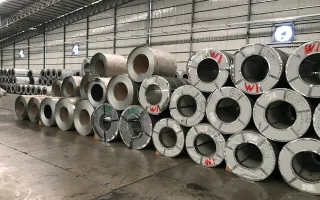
- Coils ship eye to sky (axis vertical, coil on a flat face) or eye to the side (axis horizontal, coil on its curved surface).
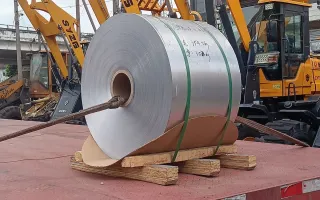
- Heavy coils sit on cradles or on timber or steel beams, never directly on the container floor.
- Steel strapping with edge protectors, timber dunnage and lashing hold the load in place.
- Our coil pages list inner diameters of 508 mm (20.00 in) [20 in] and 610 mm (24.02 in) [24 in] and coil weights up to 30 t [66,100 lb] (15 t [33,100 lb] for prepainted coil); Aluzinc coil lists neither.
- Published 20 ft and 40 ft payloads are about 25.0 t and 27.6 t, so the heaviest coils exceed a container payload.
How steel coils are packed for export
Packing protects the coil from three things: moisture, edge damage and movement. The details vary between mills, products and destinations, and no single export packing standard governs them, so the packing is agreed per order. The common elements in industry descriptions are these.
- Surface protection. The strip may be interleaved with paper or another material that protects the surface finish and helps retain oil or other rust-prevention coating. Pickled and oiled coil is oiled for this reason; see pickled and oiled hot rolled coil.
- Wrapping and edge protectors. A coil is commonly wrapped and held by steel bands, with edge protectors under the bands. The mill’s packing specification governs the build.
- Steel strapping. Steel is the oldest and highest tensile strength strapping material, used where high strength and little stretch are needed, and steel coils are among its common uses. Edge protectors are placed under the strap at the edges of a load.
- Labelling. EN 10021 lists marking and packing among the items a purchaser can specify, so state the label content you need at enquiry.
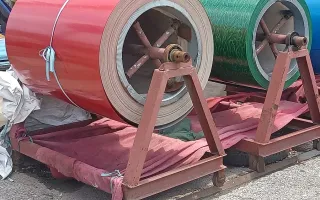
Surface quality differs by product. Prepainted coil has a finished paint surface that scratches, so ask for the protection you need; the paint systems are covered on the prepainted steel coil page and in prepainted coil paints and RAL colours. For galvanized and Aluzinc coil see galvanized coil and Aluzinc coil, and Galvalume, Zincalume and Aluzinc coil for the names of the coating.
Eye to sky or eye to the side?
| Item | Eye to sky (vertical) | Eye to the side (horizontal) |
|---|---|---|
| Coil axis | Vertical, eye facing up | Horizontal, across the container or along it |
| Rests on | A flat face | The curved surface |
| Support | Pallet or timber base | Cradles of wood or steel |
| Main risk | Tipping or sliding of the pallet | Rolling, so blocking and lashing are extensive |
| Height | Coil width sets the stack height | Coil outer diameter sets the height |
These are the common industry descriptions. There is no single rule: the shipper and the carrier decide the orientation per load.
The geometry matters as well. The container door opening is about 2.34 m wide and 2.28 m high [7.7 by 7.5 ft] and the inside is about 2.35 m wide and 2.39 m high [7.7 by 7.9 ft], so the coil outer diameter and width must fit those openings with the support underneath. To estimate outer diameter from weight, width and inner diameter, use the steel coil weight calculator.
Loading a coil into a container
- Check the container. Use a container in sound condition, with undamaged cross-members and lashing points, and inspect the lashing points for damage and corrosion before use.
- Spread the weight. The payload rating assumes an even load, but a coil concentrates its weight on a small footprint. Support it on timber or steel beams that bridge several floor cross-members. The permitted load per metre of floor length is a carrier and container figure, so check it for the container used.
- Fix the coil to its support. Strap the coil to the pallet or cradle first.
- Block and lash. Timber is used for shoring (filling voids and bracing) and for chocking against rolling. Lashing uses steel strapping or synthetic webbing, and its strength is chosen for the coil weight and the container lashing points in the securing plan.
- Never let the coil rest on the floor, or press on the container walls. Weak bracing and loading without supporting beams risk damage to the floor and the container, so the loading plan is confirmed per order with the forwarder or carrier.
For how container payloads are published and what decides the load, see container loading for wire coils; the container tables there apply to any cargo, and its loading advice is for wire, not for flat-rolled coil.
Coil weight against container payload
Published tables of dry containers give a payload of about 25.0 t [55,100 lb] for a 20 ft container and 27.6 t [60,800 lb] for a 40 ft container, with an internal length of 5.9 m and 12.03 m [19.4 and 39.5 ft]. Carriers publish their own figures, and the limit that applies is the one for the container actually used.
| Item | Value |
|---|---|
| Inner diameter listed | 508 mm and 610 mm (20.00 and 24.02 in) [20 and 24 in] |
| Maximum coil weight, hot rolled, cold rolled, galvanized | 30 t [66,100 lb] |
| Maximum coil weight, prepainted | 15 t [33,100 lb] |
| Published payload, 20 ft container | 25.0 t [55,100 lb] |
| Published payload, 40 ft container | 27.6 t [60,800 lb] |
A 30 t coil is above both published payloads, so a container order uses lighter coils, and the number of coils per container is the payload divided by the packed coil weight, rounded down, with the packing weight included. The loaded weight is confirmed per order. The Aluzinc coil page lists no coil weight or inner diameter, so these are confirmed at quotation.
Container or break-bulk?
Containers are the usual choice for coils within payload limits. Break-bulk means goods stowed on the ship as individually counted units, usually on pallets, skids or in slings, instead of in a container. It needs more labour and port handling, and break-bulk cargo has historically suffered more damage than containerised cargo, but it remains the alternative where single units are too heavy or too large for a container. Which one applies depends on coil weight, quantity and the destination port.
What to tell the trader
Reinwent is a trading and sourcing company, and coil is sourced from manufacturers in Türkiye. For a loading plan, send:
- the product and grade, with thickness and width in millimetres, and whether the coil is full-width or slit coil;
- the inner diameter, maximum coil weight and maximum outer diameter your unloading and decoiling equipment can take;
- the quantity and the container size, or the break-bulk preference;
- the eye orientation, packing, protection and labelling you require;
- the destination port and the delivery terms.
Send it through the request a quote form. For the standards that go into the order, see steel coil standards: EN 10111, 10130, 10346, the steel coil range and the guides on galvanized vs Aluzinc coil and hot rolled vs cold rolled coil.
Read next: steel coil FAQ, steel coil: Türkiye vs China, pickled and oiled steel, cold rolled coil annealing and surface quality, import steel coil from Türkiye, steel coil manufacturers in Türkiye.