 Steel
Key facts
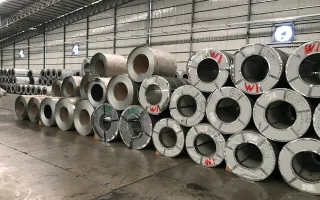
- A full-width coil (also called a master or mother coil) is strip at the width it was rolled or coated to; a slit coil is cut lengthwise from it into narrower coils.
- Slitting is a shearing operation on a line made of an uncoiler, a slitter and a recoiler.
- Slit coil has the same thickness and grade as its master coil but a cut edge, so burr, edge condition and camber must be specified.
- Strip mass is proportional to width, so slit widths that add up to the master width use all of the material; any trimmed edge strip is lost.
- Our coil product pages list slit widths from 20 mm (0.8 in) to 1500 mm (59 in) for hot rolled, cold rolled, galvanized and prepainted coil.
What slitting is
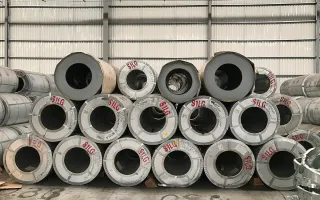
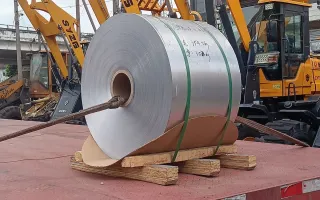
Slitting divides a wide coil lengthwise into narrow coils of the width you want. A slitting line has three main parts: an uncoiler (the unwind), a slitter and a recoiler (the rewind). The strip passes between circular knives mounted on two parallel rotating arbors, and the narrow strips are wound up again on the recoiler. The wide coil that goes in is the master coil, and the narrow coils that come out are slit coil.
Wikipedia describes roll slitting as a shearing process in which tension control is the key to good results, and IspatGuru describes the cut as passing through edge roll-over, a burnished shear zone, fracture and burr formation on the opposite edge. Nothing is added to the steel: the thickness, the grade and any coating of the master coil carry over to every slit coil.
Full-width coil and slit coil compared
| Property | Full-width coil | Slit coil |
|---|---|---|
| Width | As rolled or coated; 600 to 1650 mm (23.6 to 65 in) across our coil pages | Cut to the width ordered; 20 to 1500 mm (0.8 to 59 in) on our pages |
| Edges | Rolled edge of the master coil | Cut edge, with possible burr |
| Camber | Limits can be agreed if the application needs them | Specified and checked, more significant on narrow strip |
| Thickness, grade, coating | As ordered | Identical to the master coil |
| Coil weight | Up to 30 t (about 66,000 lb) on our hot rolled, cold rolled and galvanized pages | The master coil weight is shared among the slit coils, or set smaller by agreement |
| Processing at the buyer | Own slitting, blanking or forming from the full width | Feeds a roll-forming or tube line directly at its width |
| Material loss | None from slitting | Edge trim if the widths do not add up to the master width |
Ranges are the Reinwent sourcing ranges from the product pages. Exact limits depend on the mill and grade and are confirmed in the quotation.
Width, tolerance, edge, camber and burr
Width. The width of a slit coil is the ordered width plus or minus a tolerance. The European standard for cold rolled narrow strip, EN 10140, ties its width tolerances to the edge condition (as-rolled or slit) and to the nominal width, and gives separate tables for the two. EN 10051, for continuously hot rolled strip, lists strip under 600 mm (23.62 in) wide slit from wide strip in its scope and specifies thickness, width and edge camber for it. Quote the tolerance you need rather than assuming one.
Edge condition and burr. Slit edges are cut edges. Wikipedia notes that rough edges known as burrs are commonplace on slit edges, and IspatGuru names a dull knife and excess clearance between the knives as a main cause of burr. Lines can flatten or remove the burr in a further step, so if your process is sensitive to burr, state the maximum burr you accept.
Camber. Camber is a sideways curvature along the length of the strip, measured as the gap between an edge and a straight line. IspatGuru lists slit burr on one edge, uneven edge tension and knife overlap among its causes. EN 10140 measures edge camber over a 1000 mm (39.37 in) gauge length with two classes, and EN 10051 leaves the edge camber of slit strip under 600 mm (23.62 in) to be specified by the purchaser; if the purchaser does not choose, the mill decides.
Coil weight, inner and outer diameter
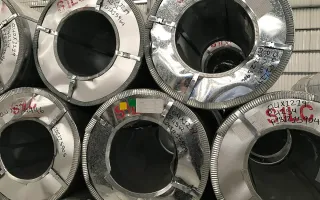
The coil is described by its inner diameter (ID), outer diameter (OD), width and weight. Our product pages list an ID of 610 mm (24 in) for hot rolled coil and 508 to 610 mm (20 to 24 in) for cold rolled, galvanized and prepainted coil, and a coil weight up to 30 t for hot rolled, cold rolled and galvanized coil.
Strip mass per metre is thickness × width × density. With thickness and width in millimetres and the density of steel at 7.85 g/cm³ (7850 kg/m³ at Engineering ToolBox), that is t × w × 7.85 ÷ 1000 kilograms per metre. A strip 1.0 mm (0.039 in) thick and 1000 mm (39.37 in) wide weighs 7.85 kg per metre, so a 30 t coil of it is about 3820 m long. Our steel coil weight calculator does these steps for you.
The outer diameter follows from the same volume: OD = √(ID² + 4 × mass ÷ (π × density × width)). For a 10 t coil of 1000 mm (39.37 in) width on a 610 mm (24.02 in) ID the OD is about 1412 mm (55.6 in). Cut that coil into four 250 mm (9.84 in) coils of 2.5 t each and each has the same outer diameter, because width and mass fall in the same proportion. The figure is theoretical, so confirm the OD limit of your uncoiler in the quotation.
Loss, yield and lead time
Because mass is proportional to width, the yield of a master coil equals the sum of the slit widths divided by the master width. A 1250 mm (49.21 in) master coil slit into four 300 mm (11.81 in) strips gives 1200 mm (47.24 in) of product and 50 mm (1.97 in) of edge trim: a yield of 96% on that example. Ask for a width plan that fits your widths to the master width.
Slitting adds a processing step, so give the slit widths, quantity and coil weight with the first enquiry. We do not quote figures for lead time or loss here because they depend on the mill and the order.
When to buy which
| Your situation | Choose |
|---|---|
| The line needs one fixed narrow width, for example roll forming or tube making | Slit coil |
| You have your own slitting line or need many different widths | Full-width coil |
| The part uses the full width of the strip | Full-width coil |
| The edge must be free of burr or camber must be tight | Slit coil, with edge and camber limits in the specification, or a rolled-edge strip |
| You want to compare a coil and its slit version | Ask for both in one quotation |
How to specify and request a quote
A complete slit coil request lists:
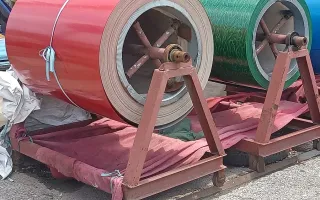
- Product and grade: for example pickled hot rolled coil, cold rolled coil, galvanized coil or prepainted steel coil.
- Thickness in mm, with the tolerance you need.
- Slit width in mm and its tolerance.
- Inner diameter, maximum outer diameter and maximum coil weight.
- Edge requirement, burr limit and camber limit.
- Packing and the quantity.
Reinwent is a trading and sourcing company that sources coil from manufacturers in Türkiye. Send the list through the quote form, and the quotation comes within 12 hours at the latest.
Related coil guides: galvanized or Aluzinc coating; hot rolled or cold rolled.
Read next: what is hot rolled steel, pickled and oiled steel, steel coil standards, steel coil packing and container loading, coil thickness and width selection, steel coil importers guide, steel coil price factors.