 Steel
Key facts
- Hot rolling starts from large pieces such as slabs and takes place above the recrystallization temperature.
- The surface is covered in mill scale, an oxide that must be removed by pickling if a clean surface is needed.
- Tolerances are usually 2 to 5% of the overall dimension, wider than for cold rolled steel.
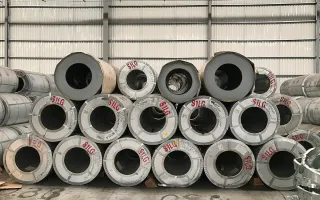
- Pickled and oiled coil has had the scale removed with acid and a thin oil film applied.
- The Reinwent range is 0.80 to 5.00 mm (0.031 to 0.197 in) thick and 600 to 1600 mm (23.6 to 63.0 in) wide.
What are the properties of hot rolled steel?
| Property | Hot rolled steel |
|---|---|
| Rolling | Above the recrystallization temperature |
| Work hardening | None; the grain structure recrystallizes |
| Surface | Mill scale, unless pickled |
| Tolerances | Usually 2 to 5% of the overall dimension |
| Directionality | Workpieces under 20 mm (0.787 in) thick often show some |
The thickness range is the main practical difference. Hot rolling can take a large reduction per pass, while cold rolling cannot reduce the thickness as much in one pass, which is why the thinner gauges and the finer surface come from cold rolling. On our product pages hot rolled pickled coil runs up to 5.00 mm (0.197 in) and cold rolled coil up to 3.00 mm (0.118 in).
What does pickled and oiled mean?
Hot rolling leaves a scale of iron oxide on the strip. In a pickling line the coil passes through acid, and hydrochloric acid is the main one used in steelmaking. The clean steel can rust quickly in humid air, so a thin film of oil is applied as a barrier against moisture. The film generally has to be removed before the steel is plated or painted. Pickled and oiled coil is both a finished product and the feedstock for cold rolling.
Hot rolled steel vs cold rolled steel
Cold rolled steel is hot rolled steel rolled again below the recrystallization temperature. It has a better surface finish, tighter tolerances and strength up to 20% higher, and it cannot be reduced as much per pass. The full comparison with ranges and standards is in hot rolled vs cold rolled coil, and the cold rolled side is explained in what is cold rolled steel.
What is hot rolled steel used for?
The product page names feedstock for cold rolling as the first use. Pickled coil is also used for automotive and construction components, for general fabrication and machine building, and for parts that are painted or coated after forming.
Which standards apply?
- EN 10111: continuously hot rolled low carbon steel sheet and strip in coils for cold forming (grades DD11 to DD14).
- EN 10025-2: non-alloy structural steels (for example S235JR, S275JR, S355JR).
- EN 10149-2: thermomechanically rolled high yield strength steels for cold forming (from S315MC).
- EN 10051: tolerances on dimensions and shape of continuously hot rolled uncoated plate, sheet and strip, for products up to 2200 mm (86.61 in) wide and 25 mm (0.984 in) thick.
Name the standard and the grade in the enquiry. Our pickled and oiled hot rolled coil page lists the ranges, and pickled hot rolled coil from Türkiye covers sourcing.
Related guides
Read coil thickness and width selection to choose the gauge, and what is pickled and oiled steel for the pickling step in more detail.
Send your specification through request a quote and the quotation comes within 12 hours at the latest.