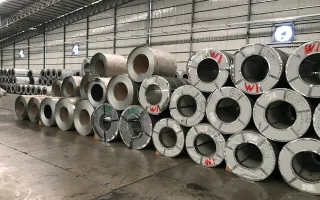
 Steel
Key facts
- Across the five coil types sourced here, thickness runs from 0.20 to 5.00 mm (0.008 to 0.197 in) [0.008 to 0.197 in] and full width from 600 to 1650 mm (23.62 to 64.96 in) [23.6 to 65.0 in]. Slit coil runs from 20 mm (0.787 in) [0.8 in] wide.
- Each coil type has its own limits: hot rolled starts at 0.80 mm (0.031 in), and Aluzinc is limited to 2.00 mm (0.079 in) thick and 1250 mm (49.21 in) wide.
- Nominal thickness of coated coil includes the coating (EN 10143), and the standards allow normal or special (S) tolerances on thickness and width.
- Strip mass per metre in kg = thickness (mm) × width (mm) × 7.85 ÷ 1000.
- For a fixed outer and inner diameter, coil weight follows width, not thickness.
What range does each coil type offer?
Thickness and width are the two numbers every coil enquiry starts with. The table lists the full range shown on each product page; exact limits depend on the mill, the grade and the coating mass, and are confirmed at quotation.
| Coil type | Thickness, mm | Width, mm | Maximum coil weight |
|---|---|---|---|
| Pickled and oiled hot rolled coil | 0.80 to 5.00 [0.031 to 0.197 in] | 600 to 1600 [23.6 to 63.0 in] | 30 t [66,100 lb] |
| Cold rolled coil | 0.20 to 3.00 [0.008 to 0.118 in] | 600 to 1600 [23.6 to 63.0 in] | 30 t [66,100 lb] |
| Galvanized coil | 0.20 to 4.00 [0.008 to 0.157 in] | 600 to 1650 [23.6 to 65.0 in] | 30 t [66,100 lb] |
| Prepainted steel coil | 0.20 to 1.50 [0.008 to 0.059 in] | 600 to 1500 [23.6 to 59.1 in] | 15 t [33,100 lb] |
| Aluzinc coil | 0.25 to 2.00 [0.010 to 0.079 in] | 600 to 1250 [23.6 to 49.2 in] | not stated |
Slit coil on our pages runs from 20 to 1500 mm (0.787 to 59.06 in) [0.8 to 59 in] wide within the thickness range of the coil. Coil inner diameter is 610 mm (24.02 in) [24 in] for hot rolled and 508 to 610 mm (20.00 to 24.02 in) [20 to 24 in] for the cold rolled, galvanized and prepainted coil.
The steel coil page shows the whole family. The heavy end, up to 5.00 mm (0.197 in), is hot rolled, and the thin end, 0.20 mm (0.008 in), is offered in cold rolled, galvanized and prepainted coil.
How do you choose thickness and width by application?
The product pages tie each coil type to its uses, but they do not give a thickness for each use. That figure comes from your drawing: the strength and stiffness the part needs, and how it is formed. The pages do show which coil types list which application: roll-formed building products, roofing and cladding (galvanized, Aluzinc, prepainted), household appliances and furniture (galvanized, cold rolled, prepainted housings), automotive parts (galvanized, cold rolled, hot rolled), ducting, ventilation and radiators (galvanized, cold rolled) and general fabrication (hot rolled, galvanized). That fixes the range you choose within.
Thickness. Choose the thinnest strip that carries the load and forms without trouble, then check that the coil type offers it.
Width. The width should match the flat pattern of the part plus whatever edge trim your line removes. A part that is much narrower than the full-width range is a case for slit coil, because the mill cuts the width you need and you do not cut it yourself. A width plan that leaves little edge trim uses the master coil best.
What do the tolerance standards say?
Every ordered size carries a tolerance, set by a dimensional standard. Take the tables from the standard named in your order.
| Standard | Covers | Stated limits and options |
|---|---|---|
| EN 10051 | Continuously hot rolled uncoated strip, including strip for cold rolling | Width up to 2200 mm (86.61 in), thickness up to 25 mm (0.984 in). Options include trimmed (T) or mill (M) edges and welded seams in coils. Excludes rolled strip under 600 mm (23.62 in) wide |
| EN 10131 | Cold rolled uncoated and electrolytically zinc coated low carbon and high yield strength strip for cold forming | Minimum thickness 0.35 mm (0.014 in), and 3 mm (0.12 in) or less unless agreed. Excludes rolled strip under 600 mm (23.62 in) wide. Normal and special (S) tolerances |
| EN 10143 | Continuously hot-dip coated strip (Z, ZF, ZA, AZ, AS) | Thickness 0.20 to 6.50 mm (0.008 to 0.256 in). Normal and special (S) tolerances. Nominal thickness includes the coating |
Three points matter when you choose a size. First, tolerance depends on the size itself. In the EN 10131 tables the thickness tolerance grows with width, from a band up to 1200 mm (47.24 in) to one over 1500 mm (59.06 in), and grows with thickness. It also grows with the yield strength of the steel, because the standard gives separate tables for yield strength bands. As one example from the soft-steel table, a nominal thickness above 1.00 and up to 1.20 mm (0.047 in) at a width up to 1200 mm (47.24 in) has a normal tolerance of ±0.06 mm [±0.002 in] and a special tolerance of ±0.040 mm [±0.0016 in]. Second, special tolerances are an order choice: both EN 10131 and EN 10143 deliver with normal tolerances unless the order says otherwise, and the letter S in the designation marks tighter ones. Third, thickness is measured at any point more than 40 mm (1.57 in) from the edges.
Two limits deserve a warning. Our cold rolled range starts at 0.20 mm (0.008 in), while EN 10131 gives a minimum of 0.35 mm (0.014 in), so for the thinnest sizes ask which tolerance basis applies. And EN 10051 lists an option that the minimum thickness equals the nominal thickness, with the whole tolerance on the plus side: name it if under-thickness matters to your part.
Does the coating change the thickness?
For coated coil the nominal thickness is the whole thickness. EN 10143 defines it as including both substrate and coating, and EN 10131 gives the same definition for coated products. So a galvanized coil ordered as 1.00 mm (0.039 in) is 1.00 mm (0.039 in) with the zinc on it. The standard also adds ±0.01 mm to the normal and special thickness tolerances for the heavy coating designations Z450 and Z600.
The coating also adds mass. Coating mass is stated in g/m² for both sides together, so a 275 g/m² coating adds 0.275 kg per metre to a strip 1000 mm (39.37 in) wide, which belongs in a precise weight. Zinc and aluminium-zinc coatings are compared in galvanized vs Aluzinc coil, and the way hot rolled and cold rolled coil differ in thickness range and surface is in hot rolled vs cold rolled coil.
How do thickness, width and coil weight relate?
Strip mass per metre follows from the size and the density of steel, 7.85 g/cm³ (7850 kg/m³): thickness (mm) × width (mm) × 7.85 ÷ 1000 gives kilograms per metre. The steel coil weight calculator applies the formula and also returns strip length and outer diameter.
| Thickness × width, mm | Mass per metre, kg | Mass per foot, lb |
|---|---|---|
| 0.50 × 1000 | 3.93 | [2.6] |
| 1.00 × 1000 | 7.85 | [5.3] |
| 1.50 × 1250 | 14.72 | [9.9] |
| 2.00 × 1500 | 23.55 | [15.8] |
| 3.00 × 1500 | 35.33 | [23.7] |
Theoretical values from density 7.85 g/cm³, without coating, packing or tolerance. 1 kg per metre is 0.672 lb per foot.
Coil weight is where size meets your handling limits. The wound strip fills a ring between the inner and outer diameter, so for a given outer and inner diameter the coil weight is proportional to the width and does not depend on the thickness. A narrow slit coil therefore weighs less than its master coil at the same outer diameter. State the weight and outer diameter your crane, uncoiler or container can take. Packing and container loading covers how coils are shipped.
Should you order by gauge or by millimetres?
By millimetres. Gauge numbers are defined differently for ferrous and non-ferrous metals, and more than one gauge standard exists, so the same number can mean different thicknesses. Wikipedia reports ASTM’s statement that the use of gauge number is discouraged as an archaic term of limited usefulness, and that outside the US thickness is usually given in millimetres. This guide therefore gives no gauge table: convert a gauge on your drawing to millimetres using the gauge system it names, and confirm the result in the enquiry.
How should you state the size in an enquiry?
- Nominal thickness and nominal width in millimetres, with the tolerance class (normal or special).
- Full-width or slit coil, and for slit coil the width, tolerance, and edge and camber requirements.
- Grade or standard and, for coated coil, the coating designation. The coil standards guide explains the designations.
- Coil inner diameter, maximum coil weight and outer diameter.
- Quantity and destination.
Order quantity is set per quotation and depends on the size, the grade and the width plan, so no single figure applies. Reinwent is a trading and sourcing company that sources coil from manufacturers in Türkiye. Send the details through the quote request form and the quotation comes within 12 hours at the latest.
Related coil guides: steel coil grades; galvanized coil finish and spangle; cold rolled coil annealing.
Read next: steel coil FAQ, what is hot rolled steel, pickled and oiled steel, what is cold rolled steel.