 Steel
Key facts
- Galvanized coil is coated with zinc (code Z). Aluzinc coil is coated with an aluminium-zinc alloy of nominally 55% aluminium, 1.6% silicon and the balance zinc (code AZ).
- Both are continuous hot-dip coatings covered by EN 10346, and by ASTM A653/A653M (zinc) and ASTM A792/A792M (55% aluminium-zinc).
- Zinc protects steel as a barrier and by corroding first. The aluminium-zinc coating combines a barrier-like aluminium-rich structure with zinc-rich areas that keep some galvanic action.
- In EN 10346 the figure in a coating designation is the nominal total coating mass of both surfaces in g/m², so Z275 is 275 g/m² and AZ150 is 150 g/m².
- Aluzinc is the choice for heat resistance and for long-life roofing and cladding. Galvanized is the usual choice for severe forming and for zinc-based protection.
What is the difference between galvanized and Aluzinc coil?
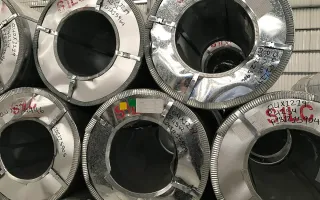
Both products are steel strip, usually cold rolled, that passes through a molten metal bath on a continuous coating line and leaves with a metallic coating on both faces. The difference is what is in the bath. Galvanized coil is coated with zinc. Aluzinc coil is coated with an alloy that ASTM A792 gives as nominally 55% aluminium, 1.6% silicon and the balance zinc. That coating is also sold as Galvalume and Zincalume, which are trade names of their owners, and the standard calls it 55% aluminum-zinc alloy-coated steel. The silicon is there to hold back the growth of a brittle alloy layer between steel and coating during manufacture, not to add corrosion resistance.
EN 10346 covers both. Its scope lists zinc (Z), zinc-iron (ZF), zinc-aluminium (ZA), aluminium-zinc (AZ), zinc-magnesium (ZM) and aluminium-silicon (AS) coatings, for strip of all widths, and the grades run from the forming steel DX51D upwards with the coating added as a suffix, such as DX51D+Z or DX51D+AZ. Multiphase steels are the exception: they are covered only with the zinc-based coatings, not with AZ.
| Feature | Galvanized coil (Z) | Aluzinc coil (AZ) |
|---|---|---|
| Coating | Zinc, with a thin zinc-iron alloy layer at the steel | About 55% aluminium, 1.6% silicon, balance zinc |
| Standards | EN 10346 (Z); ASTM A653/A653M | EN 10346 (AZ); ASTM A792/A792M |
| Protection | Barrier and strong galvanic protection | Aluminium-rich barrier structure with some galvanic protection |
| Corrosion life | Rises with coating thickness | Reported at 2 to 4 times that of galvanized in most environments |
| Heat | Not chosen for heat service | Meant for heat resistance as well as corrosion |
| Severe forming | The usual starting point | Confirm with the mill |
| Painting | Painted with little preparation, usual base for prepainted coil | Painted on the coil line or after fabrication, also a base for prepainted coil |
| Range sourced here | 0.20 to 4.00 mm (0.008 to 0.157 in) [0.008 to 0.157 in], 600 to 1650 mm (23.62 to 64.96 in) [23.6 to 65.0 in] wide | 0.25 to 2.00 mm (0.010 to 0.079 in) [0.010 to 0.079 in], 600 to 1250 mm (23.62 to 49.21 in) [23.6 to 49.2 in] wide |
How do the two coatings protect the steel?
Zinc protects in two ways. It is a barrier between steel and air, and because it is more reactive than iron it corrodes first, so the steel stays protected even at a scratch or gap in the coating. An industry reference puts it simply: the service life of zinc-coated steel is directly proportional to the zinc thickness. That is why the coating mass matters more than any other number on the order.
The 55% aluminium-zinc coating has a two-phase structure, aluminium-rich dendrites with a network of zinc-rich areas between them. The aluminium-rich part acts mostly as a barrier, and the zinc-rich areas keep a degree of galvanic protection. IspatGuru reports that in most environments this coating has been found to have 2 to 4 times the corrosion resistance of galvanized coatings, while retaining enough galvanic action to limit rust staining at edges. The ratio depends on the environment, and the sources do not give a single figure for every site.
There are environments where the advantage does not hold. Producers’ technical notes warn against bare Aluzinc in contact with wet concrete or in livestock housing, so state the end use when you ask for a quotation.
Which coating mass do you need?
EN 10346 gives each coating designation as the nominal total mass of both surfaces. The standard also sets minimum coating masses, which are checked by the triple-spot method. The zinc series runs from Z100 to Z600 and the aluminium-zinc series from AZ100 to AZ185. Deviating masses, and different masses on each surface, may be agreed at enquiry and order, and the standard warns that thicker coatings may limit formability and weldability.
| Designation | Nominal mass, g/m² | US equivalent, oz/ft² |
|---|---|---|
| Z100 | 100 | [0.33] |
| Z140 | 140 | [0.46] |
| Z200 | 200 | [0.66] |
| Z275 | 275 | [0.90] |
| Z350 | 350 | [1.15] |
| Z450 | 450 | [1.48] |
| Z600 | 600 | [1.97] |
| AZ100 | 100 | [0.33] |
| AZ150 | 150 | [0.49] |
| AZ185 | 185 | [0.61] |
US values use 1.00 oz/ft² = 305 g/m², the ASTM relationship. The galvanized range offered here is 50 to 600 g/m² and the Aluzinc range is AZ100 to AZ185.
Do not compare the two series by grams alone. The aluminium-zinc alloy is much less dense than zinc, so a gram of AZ coating is a thicker layer than a gram of zinc. The EN 10346 table lists a density of 7.1 g/cm³ for zinc coatings such as Z275 and 3.8 g/cm³ for AZ150. In US designations, AZ50 [AZM150] is 0.50 oz/ft² and G90 [Z275] is 0.90 oz/ft². G90 is the ASTM A653 designation for 0.90 oz/ft² of zinc on both sides together.
How do heat, forming and paint compare?
Heat. ASTM A792 states that the 55% aluminium-zinc product is intended for applications requiring corrosion resistance, heat resistance, or both. IspatGuru places its heat oxidation resistance between galvanized and aluminized coatings. For a part that sees real heat, take Aluzinc and ask the mill for the limit that fits your application, since this guide gives no temperature.
Forming. Both coatings come in forming grades, and the standard warns that a heavier coating may limit formability. The zinc-iron alloy layer of a galvanized coating is brittle and can powder if the strip is bent hard. Producers’ technical notes generally prefer galvanized for deep drawing, so for severe forming start with galvanized and have the mill confirm Aluzinc.
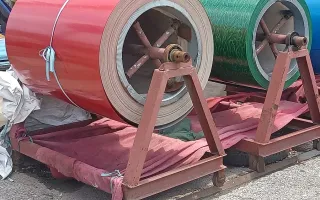
Paint. Zinc-coated steel can be painted with minimal preparation, and hot-dip surfaces often need a corrosion-inhibitive primer or a treated surface. The 55% aluminium-zinc coating can be painted by coil coating or after fabrication. EN 10346 states that its products can serve as substrates for the organic coated products of EN 10169, which is what prepainted steel coil is. Cold rolled strip is the base steel under both coatings: see cold rolled coil.
Where is each coating used, and how do you choose?
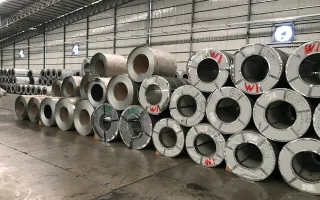
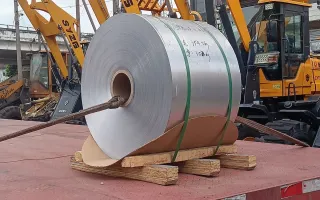
Galvanized coil is used for roll-formed building products, household appliances, automotive parts, ducting and general fabrication. Aluzinc coil is used for roll-formed building products, roofing and cladding, parts that need heat resistance, and as a base for prepainted coil. Both pages list the sourcing ranges, and the steel coil page shows the whole coil family.
- Choose galvanized when the part is bent or drawn hard, when the specification names zinc, or when the strip goes to automotive or appliance parts.
- Choose Aluzinc when the sheet will weather outdoors for a long time as roofing or cladding, or when heat is part of the duty.
- Choose the coating mass from the environment and the life you need, then ask the mill to confirm it for your thickness.
If you are not sure, send the end use, thickness and width with your quote request. Reinwent is a trading and sourcing company, and this coil is sourced from manufacturers in Türkiye.
Related coil guides: how to choose between slit and full-width coil; hot rolled or cold rolled; the steel coil weight calculator.
Read next: what is galvanized steel, galvanized vs stainless steel, Galvalume, Zincalume and Aluzinc coil, prepainted coil paints and RAL colours, steel coil standards, galvanized coil surface finish and spangle, steel coil grades DX51D, DD11 and DC01, steel coil price factors.