 Steel
Key facts
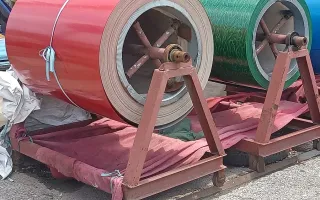
- Prepainted coil (PPGI, color coated coil) is strip painted in a continuous coil coating line before forming, so the coil leaves the line already coloured and wound.
- EN 10169 specifies requirements for continuously organic coated (coil coated) steel flat products and particularly the performance requirements. The base strip follows its own standard, such as EN 10346.
- Coil coating paints include polyesters, plastisols, polyurethanes, PVDF and epoxies. The coil offered here comes in polyester, high-durability polyester, PVDF, PUR-PA, PVC plastisol and PUR.
- Each face has its own build (a primer and a finish coat on the top side, usually a thinner backing coat on the reverse side), and colour is normally named by a four-digit RAL Classic number, stated together with the paint system and the gloss level.
- Range sourced here: 0.20 to 1.50 mm (0.008 to 0.059 in) [0.008 to 0.059 in] thick, 600 to 1500 mm (23.62 to 59.06 in) [23.6 to 59.1 in] wide, inner diameter 508 to 610 mm (20.00 to 24.02 in) [20.0 to 24.0 in], coils up to 15 t [about 33,000 lb].
How is prepainted coil made?
The coil coating process is defined in EN 10169 as a process in which an organic coating material is applied to rolled metal strip in a continuous process. On a modern line the strip is cleaned, given a chemical conversion pretreatment, dried, primed, cured, topcoated on one or both sides, cured again, cooled and rewound. The primer links the pretreatment and the finish coat and gives adhesion between them. IspatGuru sums up the idea as “finish first, fabricate later”: the paint is applied to the flat strip and the strip is formed afterwards, so the coating has to survive roll forming and bending.
The strip underneath is called the substrate. EN 10169 allows rolled steel strip with or without a metallic coating, and lists the substrate standards it accepts, among them EN 10346 for hot-dip coated strip, EN 10130 for cold-rolled strip and EN 10111 for hot-rolled strip. Other substrates are allowed only when agreed at enquiry and order. The standards behind the substrate are compared in steel coil standards: EN 10111, 10130, 10346. The standard adds that uncoated or electrolytically coated strip is normally not suitable for building exterior applications. The coil offered here is prepainted steel coil on a galvanized coil base, and an aluminium-zinc base (Aluzinc coil, explained in Galvalume, Zincalume and Aluzinc coil) is also used; the two bases are compared in the guide galvanized vs Aluzinc coil.
Polyester, PVDF, PUR or plastisol: which paint system?
Neutral sources name the families but rank them only loosely, so this table keeps to what they state and to what the product page lists. It is not a performance ranking.
| Paint system | What the sources state | Offered here |
|---|---|---|
| Polyester | A standard coil coating paint. IspatGuru names silicone polyester for better resistance to fading in sunlight, and says a vinyl coating is to be used instead of polyester for a deep draw. | Polyester; high-durability polyester |
| PVDF | Used in high-end metal paints, described as having extremely good gloss and colour retention, on metal roofing and prominent buildings. | PVDF |
| Polyurethane (PUR, PUR-PA) | Listed among the coil coating paints. The neutral sources read do not describe its properties, so ask the mill for the data of the system. | PUR-PA; PUR |
| PVC plastisol | A dispersion of PVC particles in a plasticizer that fuses when heated. IspatGuru notes that an aggressive environment may call for a plastisol coating. | PVC plastisol |
| Epoxy | Listed among the coil coating paints, not part of the range offered here. | Not offered |
Film thickness, service life and warranty terms differ by mill and system and are not given here. Ask for the technical data of the exact system, and state the end use.
The choice follows the duty. IspatGuru states that the buyer should weigh the fabrication requirements, the service life desired and the expected service conditions, and gives examples: roll-formable paint for pre-engineered buildings, a high-gloss finish that bends without cracking for appliances. Give the destination country and the end use rather than asking for “the best paint”. The slit and full-width forms of the same coil are explained in slit coil vs full-width coil.
What are the top side and the reverse side?
A prepainted coil is two coating builds on one strip. The top side is the face that shows. It carries a primer and a finish coat, which EN 10169 describes as a multi-coat system (priming, intermediate and top coat) as needed. The reverse side usually carries a backing coat, applied with or without a primer. Wikipedia notes that it is generally thinner than the finish coat, is not exposed to a corrosive environment and is not visible in the end product. For sandwich panels and roll-formed profiles this means the two faces can differ in system and colour, so say explicitly what each face needs. If you want the same paint on both faces, write it in the enquiry. The coating is applied on one or both sides, so never assume.
What is a RAL colour, and how do you specify it?
RAL is a European colour management system created and administered by the German RAL gGmbH. In everyday use “RAL” means RAL Classic, which is mainly used for varnish and powder coating and is the usual way to name the colour of prepainted coil. A RAL Classic number has four digits, and the first digit gives the shade range:
| First digit | Colour family |
|---|---|
| 1 | Yellow |
| 2 | Orange |
| 3 | Red |
| 4 | Violet |
| 5 | Blue |
| 6 | Green |
| 7 | Grey |
| 8 | Brown |
| 9 | White and black |
RAL Design is a separate collection for architects and designers, with seven-digit numbers that encode hue, lightness and chroma and no colour names, and its colours do not overlap with RAL Classic. RAL Effect is another collection, with solid and metallic colours made on waterborne paint systems. Write the collection and the number, for example “RAL Classic” followed by the four digits, and do not rely on a screen or a printed sample to define the shade. EN 10169 lists colour and gloss among the general properties tested, so both belong in the order. Gloss levels are named by the mill, so state the level you need and ask the mill to confirm it for the paint system. Colours that are not standard are agreed at quotation.
How do you write the enquiry?
Put these items in the quote request, in this order:
- Thickness and width in millimetres, full-width or slit coil, and the coil weight and inner diameter (see the steel coil weight calculator for coil weight and length).
- Substrate: galvanized or Aluzinc, the grade and the coating designation, with EN 10346 or ASTM A653/A792.
- Paint system, for example polyester, PVDF or PUR-PA, and the requirement of EN 10169.
- Top side: RAL number, gloss level. Reverse side: system and colour.
- End use and destination, so the mill can confirm the system and category for the exposure.
- Quantity and shipping terms.
If you are choosing a base first, the guide hot rolled vs cold rolled coil explains the steel under the zinc. A painted surface scratches, so ask how it is protected in transit: see steel coil packing and container loading. The whole range is on the steel coil page. Reinwent is a trading and sourcing company, and this coil is sourced from manufacturers in Türkiye.
Read next: galvanized coil surface finish and spangle.