 Steel
Key facts
- Wire rod is described in the customs nomenclature as bars and rods, hot-rolled, in irregularly wound coils.
- Commercial wire drawing starts from a coil of hot-rolled rod, and drawing pulls it through successively smaller dies.
- For iron and non-alloy steel, wire rod belongs to heading 7213 and wire to heading 7217.
- Hot-rolled products are covered in mill scale and are held to looser tolerances than cold-worked ones, and rod scale is removed before drawing.
- Reinwent sources steel wire from Türkiye and does not offer wire rod.
The short answer
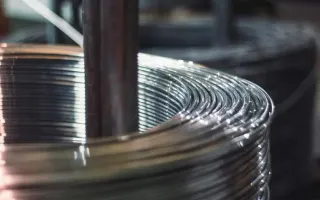
Wire rod and wire sit one step apart in the same production chain. A rolling mill squeezes hot steel down to a small round section and winds it into a coil: that is rod. A drawing line then takes the coil, cleans it and pulls it through dies to a fixed diameter: that is wire. Wire for tying, fixing, forming or springing has been through the second step. For the full route see the wire drawing process, and for cold working see what cold drawn wire is.
What is wire rod?
The customs nomenclature words it as bars and rods, hot-rolled, in irregularly wound coils, of iron or non-alloy steel. Three ideas sit in that wording.
- Hot-rolled. Wikipedia defines hot rolling as rolling above the recrystallization temperature of the material. Continuous mills, it adds, are widely used to produce rods, bars and strips.
- Coiled. The rod leaves the mill wound into coils, and the nomenclature calls the winding irregular.
- A starting product. IspatGuru lists wire rod to wire in a coil as one of the routes a drawing line runs, and Wikipedia says commercial wire drawing usually starts with a coil of hot-rolled rod.
We quote no rod diameter, because rod is not a product we sell.
How wire is made from rod
Wire is not rolled to size. It is drawn, and the steps before and after the dies are part of what makes it wire.
- Descaling. Hot rolling leaves oxide on the surface, which Wikipedia calls mill scale. Wikipedia says the surface is first treated to remove scale, and IspatGuru names mechanical cleaning with steel abrasives as the usual method, with acid pickling as an alternative.
- Pointing. The end of the rod is narrowed so that it can be fed through the first die and gripped.
- Drawing. The rod is pulled through a die with a smaller hole. Both sources note that one draw is usually not enough, so the rod passes through successively smaller dies.
- Annealing, if needed. Wikipedia says intermediate anneals counter cold working and allow further drawing, and that a final anneal can be applied to the finished product. Annealing is a heat treatment that increases ductility and reduces hardness.
- Coating, if needed. Wire can be given a zinc coating after drawing, which is how galvanized wire is made.
Our guides on hard drawn vs annealed wire and what annealed wire is cover the condition, and what galvanized wire is covers the coated case.
Wire rod and wire compared
The table keeps to what the sources state. No source we read gives a rod tolerance figure, so none is shown.
| Feature | Wire rod | Steel wire |
|---|---|---|
| Made by | Hot rolling in a mill | Cold drawing through dies, from rod |
| Role | Starting product and raw material | Finished, sized product |
| Form | Irregularly wound coils | Coils of a stated diameter |
| Surface | Covered in mill scale | Scale removed before drawing; smooth bright finish is an aim of drawing |
| Dimensions | Looser tolerances, as for hot-rolled products | Precise cross-section; EN 10218-2 sets diameter tolerances |
| Strength | Not work hardened, because hot rolling recrystallizes the grains | Raised by drawing, lowered again by annealing |
| HS heading | 7213 (iron or non-alloy steel) | 7217 (iron or non-alloy steel) |
Dimensions need care. Wikipedia says hot rolling gives looser dimensional tolerances than cold rolling, and IspatGuru says drawing makes wires to very specific and precise cross-sectional dimensions. Both statements are about the processes in general. For wire, EN 10218-2 covers diameter tolerances of round steel wire, according to the BSI and iTeh catalogue entries, and a quotation should name it.
Why customs treats them differently
The Harmonized System keeps rod and wire apart. Wire rod is in heading 7213, hot-rolled bars and rods in irregularly wound coils. Wire is in heading 7217. The Chapter 72 notes, printed by both the World Customs Organization and the US schedule, define wire as cold-formed products in coils with a uniform solid cross-section along the whole length. The line between the headings is hot-rolled against cold-formed.
The split of heading 7217 by surface, and who confirms the final code, are in our guide to steel wire HS codes. The classification belongs to you and your customs broker.
Which one should you order?
- Tying, binding or bundling. Soft, ductile annealed wire that twists by hand, covered in black annealed wire uses. Rod is not the product for this.
- Fasteners and small hardware. Nails, staples, bolts and screws are made from drawn wire of a controlled diameter and strength. See cold drawn wire and bright wire.
- Springs. Spring parts are formed from high carbon spring wire; see what spring wire is.
- Outdoor or damp use. Ask for a coated product, since neither rod nor bare wire carries zinc.
If you run your own drawing line, rod is your raw material and you should buy it from a rod supplier. If you use wire, buy wire, and check that a quotation saying wire does not describe rod. How an order is built up is in how steel wire is priced.
What to state when you need wire
Say that you need drawn wire, not rod, and then give:
- Diameter in millimetres. Convert gauge numbers with the wire gauge chart.
- Condition. Hard drawn, annealed or coated, with a tensile strength band in N/mm² where strength matters.
- Standard. EN 10218-2 for bare wire, and EN 10244-2 or ASTM A641 for zinc-coated wire.
- Coil weight, quantity and port. See the container loading guide for how coils ship.
Steel wire from Türkiye, not wire rod
Reinwent is a trading and sourcing company, not a manufacturer. We source steel wire from manufacturers in Türkiye, collect their offers and put them on one basis so that you compare like with like. Our ranges are galvanized wire at 0.8 to 8 mm with a coating weight of 50 to 300 g/m², black annealed wire at 0.8 to 8 mm, cold drawn wire at 0.8 to 6 mm and 500 to 1,000 N/mm², and high carbon spring wire. See galvanized wire from Türkiye, black annealed wire from Türkiye, cold drawn wire from Türkiye and spring steel wire from Türkiye.
We do not offer wire rod, and we do not promise to source it. If rod is what you need, we are not the right supplier.
If wire is what you need, a quotation reaches you within 12 hours at the latest, and we stay in contact until delivery. Some products are available from stock. Send your diameter, condition and destination, and request a quote.