 Steel
Key facts
- Bright wire is a trade name for drawn steel wire that carries no coating.
- EN 10218-2 covers the diameter tolerances of bright steel wire, which it defines as uncoated, together with metallic coated and non-metallic coated wire.
- Drawing is done cold, and cold working raises hardness, yield strength and tensile strength while lowering ductility.
- Bright wire has no zinc or other coating, so it can rust where moisture and oxygen reach it.
- Reinwent’s cold drawn wire, also called bright wire, runs from 0.8 to 6 mm with a tensile strength of 500 to 1,000 N/mm².
The short answer
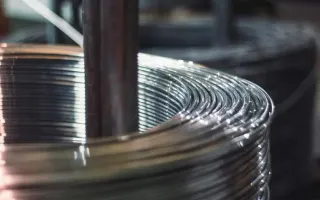
Bright is a surface word. A buyer who asks for bright wire is asking for steel wire that went through the drawing line and was then left as it came out, with no zinc and no other layer on top. It is a name from the wire trade, not a grade, so it tells you about the surface and says nothing about carbon content or strength.
The die-by-die process sits in our guide to what cold drawn wire is, and we do not repeat it. This page covers what bright means, how it differs from black and galvanized wire, its uses and what to state in an order.
What does bright mean in the wire trade?
The word has a narrow meaning. EN 10218-2, the European standard on diameter tolerances for round steel wire, applies to three forms: bright steel wire, which it defines as uncoated, metallic coated steel wire and non-metallic coated steel wire. The BSI and iTeh catalogues both give that scope. So in a standard, bright is the opposite of coated.
It is not a claim about shine. Our cold drawn product page says bright means an unfinished, uncoated surface and that it does not mean polished, and we keep to that reading. The finished surface does come from drawing, though. IspatGuru lists a smooth, bright surface among the aims of drawing, and a separate aim is improving the finished surface. Wikipedia adds that the rod is treated first to remove scale, and that good lubrication in the drawing process is essential for surface finish and die life.
No source gives a roughness value for bright wire, and we quote none. If the look of the coil matters, ask for a sample.
How drawing gives bright wire its surface and strength
Two things happen at the drawing line, and a buyer meets both in the wire.
The surface is prepared and then kept clean. Scale is removed from the rod before it enters the first die. Lubricant then helps each pass leave a better surface. No coating is applied afterwards, which is why the result is called bright.
The steel gets stronger. Drawing is done at room temperature, so the steel is cold worked. Wikipedia defines work hardening as an increase in strength during plastic deformation, and states that cold working increases hardness, yield strength and tensile strength, while the ductility of a work hardened material is reduced. IspatGuru also says cold working strengthens the steel, and that drawn products have precise dimensions.
Put together, bright wire is hard, accurately sized and uncoated. Wikipedia notes that intermediate anneals are sometimes needed so drawing can continue, so the tensile band you request is what fixes the end result. How that band is written is in our guide to high tensile wire.
Bright wire compared with black annealed and galvanized wire
| Feature | Bright wire | Black annealed wire | Galvanized wire |
|---|---|---|---|
| Surface | Uncoated | Uncoated | Zinc coated |
| Condition | Hard, as drawn | Soft, heat treated | Set by the product |
| Reinwent tensile range | 500 to 1,000 N/mm² | 300 to 450 N/mm² | Not stated on the product page |
| Typical jobs | Fasteners, small hardware | Tying and binding | Work exposed to moisture |
Against black annealed wire the surface is the same in principle, because neither carries a coating. What separates them is the last step. Annealing is a heat treatment that increases ductility and reduces hardness, so black annealed wire is soft and ties by hand, while bright wire keeps the strength of drawing. We found no source that compares the surface of the two finishes, so we claim no visible difference. See what annealed wire is, hard drawn vs annealed wire and black annealed wire uses for the soft side.
Against galvanized wire the difference is the coating. Galvanized wire has zinc over the steel, and bright wire has nothing. Our guide to what galvanized wire is explains how zinc protects. The choice usually follows exposure.
Can bright wire rust?
Yes, and the sources give the reason. SteelConstruction.info states that corrosion of steel needs moisture and oxygen at the same time. Wikipedia’s article on rust says the same for iron and its alloys, and adds that salt speeds the process. A bare steel surface has no barrier against either.
Dry storage and dry or covered uses leave little moisture for the reaction, while wet or salty air speeds it. We quote no lifespan, because no source we fetched gives one for bright wire. Where the finished part is coated after forming, a bare drawn wire can be the right starting material. Where the wire itself stays outdoors, ask for galvanized wire instead, offered in diameters from 0.8 to 8 mm with a coating weight of 50 to 300 g/m².
What bright wire is used for
The list below is the use list on our product page, and we add no others.
| Use on the product page | What the job asks of the wire |
|---|---|
| Nails and staples | A stiff wire that holds its shape |
| Bolts and screws | A strong wire of steady diameter |
| Other fasteners and small hardware | A clean wire that forms into small parts |
These are all parts made from wire, so strength and steady diameter count more than softness. A wire knotted by hand is a different product. The last row is broad on purpose: the product data lists no narrower parts.
What to specify when you order bright wire
Bright is only a surface word, so an order needs more than the name.
- Diameter in millimetres. Reinwent quotes bright wire from 0.8 to 6 mm. If your drawing gives a gauge number, convert it with the wire gauge chart before you write the request.
- Tensile strength range. State the band you need inside 500 to 1,000 N/mm².
- Standard. Name EN 10218-2. It sets diameter tolerances only, so it tells you how exact the size is, not how strong the wire is.
- Coil weight. Say which coil weight your line takes, because packing is part of the specification.
Then state the surface (bright, or the coating you want), the quantity and the port.
Bright wire from Türkiye
Reinwent is a trading and sourcing company, not a mill. We buy bright wire from manufacturers in Türkiye, collect several offers against your specification and put them on one basis, so you compare like with like. Some products are available from stock. Our page on cold drawn wire from Türkiye describes the supply route, and the cold drawn wire product page lists the range: 0.8 to 6 mm, 500 to 1,000 N/mm², EN 10218-2.
A quotation reaches you within 12 hours at the latest, and we stay in contact until delivery. When the diameter, strength band, coil weight and surface are settled, request a quote.