 Steel
Key facts
- Drawing reduces the cross-section of wire rod by pulling it through a die smaller than the incoming material.
- Cold working means shaping metal below its recrystallization temperature, usually at room temperature.
- Cold work raises hardness, yield strength and tensile strength, and lowers ductility.
- Bright wire is drawn wire left without a coating; EN 10218-2 lists bright steel wire as uncoated.
- Dies for wire drawing are made of tool steel, tungsten carbide or diamond.
What makes wire cold drawn?
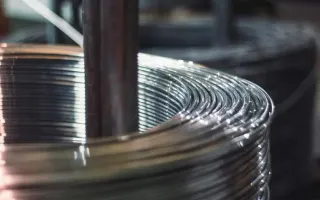
Drawing is a metalworking process that reduces the cross-section of a piece of metal by pulling it through a die, a tool with a hole smaller than the incoming material. For steel wire the starting material is wire rod, which is a different product from wire (see wire rod vs wire). The rod goes in at one diameter and comes out thinner and longer. It is one of the types of steel wire we supply.
The word cold refers to temperature. Cold working means shaping metal below its recrystallization temperature, which in practice usually means at room temperature. Wire drawing is normally carried out this way, so when a buyer asks for drawn wire, the product they get is almost always cold drawn.
How is cold drawn steel wire made?
A drawing line turns rod into finished wire in a few steps, and the wire drawing process guide covers the whole route.
- Surface cleaning. Cold working needs a clean surface free of scale. Scale on the rod is removed first.
- Pointing. The end of the rod is reduced so it can be threaded through the first die and gripped on the other side.
- Drawing through dies. The rod is pulled through a die, and usually through several in a row, each one a little smaller than the last. One draw is rarely enough to reach the final size.
- Lubrication. A lubricant is applied in wet or dry form, or as a metal coating. It extends die life and gives a better surface finish.
Dies for this work are made of tool steel, tungsten carbide or diamond.
If the wire becomes too hard to draw further before it reaches size, it can be given an intermediate anneal and then drawn again. That annealing step is optional and depends on how far the wire has to be reduced.
Why does drawing make wire stronger?
Each pass deforms the steel plastically, and plastic deformation makes steel stronger. This is work hardening, also called strain hardening: cold work raises hardness, yield strength and tensile strength. For how that strength is measured and compared between offers, see our guide to high tensile wire.
There is a trade-off. Work hardened steel is less ductile, so cold drawn wire bends less easily than annealed wire. That is the reason drawn wire and annealed wire end up on opposite sides of the strength scale. The more a wire has been reduced since its last anneal, the more work hardening it carries, which is why the drawing schedule and any intermediate anneal shape the properties of the finished coil.
Cold working also has practical benefits that matter to anyone making parts from wire: better surface finish and closer dimensional control than hot working gives. The references name both, without giving one tolerance figure for drawn wire. The tolerance that applies to your order comes from the standard you name.
Cold drawn vs annealed wire
Both products begin the same way, as drawn steel wire. The difference is what happens at the end.
| Feature | Cold drawn wire | Black annealed wire |
|---|---|---|
| Last step | Final drawing pass | Heat treatment after drawing |
| Condition | Work hardened | Softened, ductility restored |
| Behaviour | Stronger, holds its shape | Softer, easy to twist by hand |
| Tensile strength on our range | 500 to 1,000 N/mm² | 300 to 450 N/mm² |
| Diameter on our range | 0.8 to 6 mm | 0.8 to 8 mm |
| Typical jobs | Nails, staples, bolts, screws, small hardware | Tying and binding in construction |
The strength figures are the ranges we quote for each product, both to EN 10218-2. For the soft side of this pair, read our explainer what is annealed wire, or the fuller hard drawn vs annealed wire comparison.
What is bright wire?
Bright wire (see our bright wire guide) is the trade name for drawn wire left without a coating. EN 10218-2, the standard that sets the diameter tolerances for round steel wire, uses the word the same way: it lists bright steel wire as uncoated, next to metallic coated and non-metallic coated wire. Drawing itself aims at a smooth, bright surface, which is where the name fits naturally.
Bright does not mean protected. An uncoated steel surface has no zinc to shield it, so if the wire will be exposed to moisture, a coated product such as galvanized wire may suit better. Our guide to hot-dip vs electro-galvanized wire explains how zinc coatings differ.
What is cold drawn wire used for?
The combination of strength and a clean, accurately sized surface makes drawn wire a raw material for parts. References give springs of all kinds, staples and paper clips as examples. Our cold drawn wire is offered in diameters from 0.8 to 6 mm with a tensile strength of 500 to 1,000 N/mm², to EN 10218-2, and is used for:
- nails and staples;
- bolts and screws;
- other fasteners and small hardware.
For spring work, compare it with our high carbon spring wire, listed with every other wire type on the steel wire hub.
How do you specify cold drawn wire in a request?
Give the diameter in millimetres, the tensile strength band you need, the standard, the quantity and the destination. If your drawing gives a gauge number, the wire gauge chart converts it. A narrow strength band inside the range is worth stating up front, because it decides which offers are comparable.
Sourcing from abroad? Our page on cold drawn wire from Türkiye covers specifications and ordering, and the container loading guide for wire coils explains how coils are shipped. Reinwent is a trading company, not a manufacturer. When you are ready, request a quote and we collect offers for you.