 Steel
Key facts
- Annealing is a heat treatment that makes steel softer, more ductile and freer of internal stress.
- Drawing is cold work: it raises hardness and strength and lowers ductility, an effect called work hardening.
- During annealing, new strain-free grains replace the grains deformed by drawing (recrystallization).
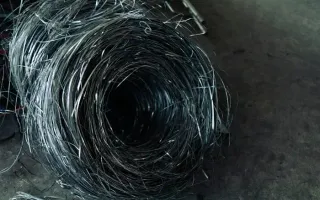
- Black annealed wire is a final-annealed, uncoated wire, sold as tie wire and binding wire.
- Annealed wire is not a separate grade of steel, but drawn wire given back its ductility.
What does annealed mean for steel wire?
Annealing is a heat treatment. The metal is heated so that its internal structure can rebuild itself and then cooled, and the result is a steel that is softer, more ductile and freer of internal stress than before. References on steel describe it first and foremost as a softening treatment.
Wire needs this step because of the way it is made. Steel wire is formed by pulling rod through dies, and that drawing is cold work. Cold work raises hardness and strength but lowers ductility, an effect known as work hardening or strain hardening. A drawn wire is therefore stiff and springy. Annealing undoes the work hardening, and the wire becomes soft enough to wrap, twist and knot by hand.
So annealed wire is not a separate grade of steel. It is drawn wire that has been given back its ductility on purpose.
How is annealed wire made?
The route has three broad stages, and every annealed wire passes through them in some form.
- Cleaning the rod. Before drawing, scale is removed from the surface of the rod, because cold working needs a clean, scale-free surface.
- Drawing to size. The rod is pulled through successively smaller dies, usually several of them, with a lubricant to protect the surface and the dies. Each pass makes the wire thinner, longer and harder.
- Annealing. The drawn wire is heated until recrystallization takes place: new, strain-free grains form and replace the grains deformed by drawing. It is then cooled. The softening comes from this rebuilt grain structure.
Annealing can also happen in the middle of the route. When a wire has become too hard to draw further without breaking, an intermediate anneal restores enough ductility to carry on. References call this process annealing. The whole route is in the wire drawing process guide. A final anneal on the finished size is what turns drawn wire into the soft product sold as annealed wire, set against hard drawn wire in hard drawn vs annealed wire.
This guide gives no furnace temperatures or times. They depend on the steel and the equipment, and the references we checked describe the principle rather than one set of figures for wire.
Types of annealed wire
Annealed wire is usually told apart by two things: its surface and the point at which it was annealed.
| Basis | Variant | What it means |
|---|---|---|
| Surface | Annealed in air | Heating in air can oxidize the surface and leave scale |
| Surface | Annealed in a protective atmosphere | A special gas atmosphere is used when scale must be avoided |
| Coating | Black annealed | No zinc coating on the finished wire |
| Stage | Intermediate (process) anneal | Softens the wire partway so drawing can continue |
| Stage | Final anneal | Softens the wire at its finished size for use |
For a buyer of tie wire, the variant that matters is black annealed wire: a final-annealed, uncoated wire. The word black separates it from galvanized wire, and the surface can be darkened further by oxide from annealing in air.
What is black annealed wire used for?
Its whole value is softness. A tie wire has to be wrapped around what it holds, twisted tight and cut, usually by hand. Drawn wire that has not been annealed is harder and less ductile, which makes that work harder. Annealed wire is easy to twist and bend.
That is why black annealed wire is sold as tie wire and binding wire (see our binding wire guide for importers). Typical jobs are:
- binding and fixing in general construction work;
- other tying jobs that need a soft, flexible wire.
Our guide to black annealed wire uses takes each job in turn.
Our black annealed wire is offered in diameters from 0.8 to 8 mm with a tensile strength of 300 to 450 N/mm², to EN 10218-2. If your drawings give a gauge number, convert it with the wire gauge chart before you send the request; binding wire gauge sizes shows 18 gauge in each system.
Annealed wire vs galvanized wire
The question buyers ask most often is whether to pay for a zinc coating. The two wires answer different needs.
| Feature | Black annealed wire | Galvanized wire |
|---|---|---|
| Main treatment | Heat treatment that softens the steel | Zinc coating applied to the steel |
| Surface | Uncoated | Zinc |
| Corrosion protection | None from a coating | Zinc acts as a barrier and corrodes in place of the steel |
| Main reason to choose it | Soft, easy hand tying | Exposure to weather or moisture |
Zinc protects steel in two ways. It is a barrier between the steel and the air, and because it corrodes in preference to the steel, it keeps protecting even at a scratch. Black annealed wire has neither defence, so it suits work where the wire is covered soon after tying or corrosion is not a concern. Our guide to black annealed vs galvanized tie wire takes this comparison further, and hot-dip vs electro-galvanized wire explains how the zinc is applied.
Annealed wire vs cold drawn wire
Cold drawn wire is the same steel without the final softening. It keeps the strength that drawing gives it, and loses ductility in exchange. On our range that shows in the numbers: cold drawn wire is offered at 500 to 1,000 N/mm², well above the annealed band. Pick drawn wire when the part must hold its shape and carry load, as in fasteners. Pick annealed wire when the job is bending and tying. Our explainer what is cold drawn wire covers the hard side of this pair.
What should you put in a request for annealed wire?
State the diameter, the tensile strength band, the standard, the quantity and the destination. Say whether you need black wire or a coated wire, because that changes which offers can be compared. If you have a preferred coil weight or packing, add it too. Our tie wire guide for importers walks through every order field for both finishes.
Buying from abroad? Our page on black annealed wire from Türkiye explains how ordering works, and the container loading guide for wire coils shows how coils are shipped. Every wire type we supply is listed on the steel wire hub. Reinwent is a trading company, not a mill: when your specification is ready, request a quote and we collect offers from manufacturers for you.