 Steel
Key facts
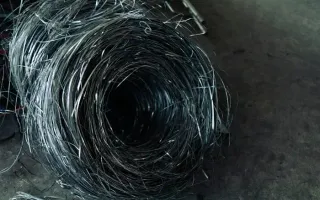
- Black annealed wire is used for binding and fixing in construction work, for tying jobs that need a soft wire, and for bundling and securing.
- Annealing is a heat treatment that increases ductility and reduces hardness, which is why the wire can be knotted by hand.
- Iron rusts when it meets water and oxygen, and black annealed wire has no zinc coating to block them.
- Galvanized wire carries zinc that acts as a barrier and corrodes in place of the steel, so it suits tied work that stays exposed.
- Binding wire and tie wire are trade names for the same soft black annealed wire.
The short answer
Black annealed wire has one main job: holding things together with a knot or a twist. A worker wraps it round the parts, pulls it tight, twists the ends and cuts the tail, usually without tools beyond pliers. That only works with a wire that bends easily and stays bent, and annealed steel does both.
Binding wire, tie wire and annealed tie wire are trade names for this one wire; our tie wire guide lists the order fields. This guide covers each use on the product page, why softness is the reason, and the question buyers ask most: does it rust? For the other kinds, see types of steel wire.
What black annealed wire is used for
| Use on the product page | What the job asks of the wire |
|---|---|
| Binding and fixing in construction work | A wire that can be wrapped and twisted tight by hand |
| Tying jobs that need a soft, flexible wire | A wire that follows the shape of what it holds |
| Bundling and securing with a soft wire | A wire that can be pulled round a load and knotted |
Tying and binding in construction is the use buyers search for most. The wire is wrapped round the parts being joined, twisted tight and cut, so the first test is how easily it works by hand.
Tying jobs that need a soft, flexible wire are not always construction. They share the need for a wire that bends round an awkward shape without springing back.
Bundling and securing means drawing a soft wire round a load, closing it and knotting it. Reinwent lists no narrower jobs, and we add no uses that the product page does not state. A job that needs a stiffer wire calls for a different product, such as cold drawn wire, also sold as bright wire.
Why a soft annealed wire suits tying
Steel wire is hardened by drawing. Wikipedia defines annealing as a heat treatment that alters the properties of a material to increase its ductility and reduce its hardness, making it more workable, and IspatGuru adds that annealing becomes necessary after cold working such as wire drawing. It also names steel wire as a material annealed to improve ductility and to relieve internal stress.
For the person holding the wire this has two effects:
- It twists without cracking. A ductile wire takes a tight turn instead of snapping.
- It stays put. A soft wire keeps the turn you give it instead of springing back.
Reinwent’s black annealed wire has a tensile strength of 300 to 450 N/mm² and is offered to EN 10218-2. That standard sets tolerances on the diameter of round wire. It does not rate how well a wire ties, so treat it as a dimension check. The full explanation of how the softening is done is in our guide to what annealed wire is.
Why is it called black?
In the trade, black means the wire has no coating, as opposed to galvanized wire. That is the meaning we can state with confidence.
The surface colour is a different matter. Both Wikipedia and IspatGuru say that the high heat of annealing can oxidize the surface of steel and form scale, and that a protective atmosphere is used when scale must be avoided. Neither source says what colour that scale gives an annealed wire, so this guide does not claim that oxide is the reason for the name. If the look of the wire matters to your customer, say so in the request and ask for a sample.
Does black annealed wire rust?
This is the question on which retailers disagree, and the sources help settle it.
SteelConstruction.info states that the corrosion of steel needs moisture and oxygen at the same time, and that without either one it does not occur. Wikipedia’s article on rust says the same for iron and its alloys, adds that salt makes rusting faster, and notes that surface rust is flaky and gives the iron under it no lasting protection.
Applied to tie wire, that means:
- Black annealed wire can rust. It has no zinc, so nothing stands between the steel and the air.
- Dry storage and dry work leave no moisture for the reaction.
- Covering the tie soon takes it out of the weather.
- Wet or salty air speeds rusting.
Sellers who say black wire never rusts and sellers who say it rusts fast each describe one set of conditions. Exposure decides. We quote no lifespan, because no source we fetched gives one for tie wire.
Galvanized wire answers the exposure problem differently. The American Galvanizers Association describes zinc as a barrier that also corrodes first at breaks in the coating, and Wikipedia’s galvanization article agrees that zinc protects in this way. Our guide to black annealed vs galvanized tie wire sets the two side by side, so we do not repeat it here. For reference, Reinwent’s galvanized wire is offered in diameters from 0.8 to 8 mm with a coating weight of 50 to 300 g/m².
Choosing a size for the job
Nobody can pick a diameter from a use alone. The size depends on what is being tied, how many turns the tie makes and how the crew works. Reinwent does not prescribe a gauge for any use, and no source we checked ties a use to one.
What we can help with is the arithmetic of ordering:
- State the diameter in millimetres. Black annealed wire is quoted by Reinwent from 0.8 to 8 mm.
- Convert gauge numbers first. The same gauge number is a different size in SWG, BWG and the US Steel Wire Gauge. Use the wire gauge chart or read binding wire gauge sizes.
- Add coil form and quantity. Packing is part of the specification, so state the coil weight you prefer.
If you import binding wire
Importers send the same request wherever the wire is going: specification, offers on one basis, port and shipping terms. The binding wire guide for importers covers the full order. Two destination guides go further, one for binding wire for the UAE and one for binding wire for Nigeria. Duties and documents depend on the destination, so check them with your customs broker.
Black annealed wire from Türkiye
Reinwent is a trading and sourcing company, not a mill. We buy black annealed wire from manufacturers in Türkiye, collect several offers against your specification and put them on one basis so you compare like with like. Our page on black annealed wire from Türkiye describes the supply route, and the product page lists the black annealed wire range: diameters from 0.8 to 8 mm and a tensile strength of 300 to 450 N/mm², to EN 10218-2.
A quotation reaches you within 12 hours at the latest, and we stay in contact until delivery. When the size, finish, quantity and port are ready, request a quote.