 Steel
Key facts
- Wire drawing pulls steel through dies, so the diameter falls and the length rises while the volume stays the same.
- Commercial wire drawing usually starts from a coil of hot rolled wire rod, so the rod is the raw material of drawn wire.
- Incoterms rules set which tasks, costs and risks sit with the seller and which with the buyer.
- Incoterms rules do not set the amount payable, the currency or the credit terms.
- Under CIF and CIP the seller must insure the goods in transit, and under CFR and CPT the seller need not.
What goes into the cost of a steel wire order?
A quotation for steel wire is a stack of separate items, and one headline figure hides most of them. Reinwent publishes no prices, so this guide names the items instead, and you can ask every supplier to quote on the same basis. They are the raw material, the work that brings the wire to its diameter, any coating or heat treatment, the temper, coil weight and packing, quantity, delivery term with freight and insurance, and payment terms with currency.
How do wire rod and drawing shape an order?
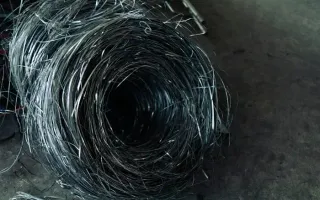
Drawn steel wire starts as wire rod. Wikipedia describes commercial wire drawing as starting with a coil of hot rolled wire whose surface is first treated to remove scale, and IspatGuru lists wire rod to wire in a coil as a drawing route; see wire rod vs wire. What a mill paid for the rod reaches the quotation. We quote no rod figure and name no index, because a number on a page cannot describe your order.
Drawing is where the diameter comes from. The wire is pulled through a die, and because its volume stays the same, the length grows as the diameter shrinks. Reaching the final size usually takes more than one pass through successively smaller dies, and a large reduction may need an intermediate annealing. So the diameter is more than a size label: ask for one figure in millimetres for each item. Gauge numbers differ between systems, so convert with the binding wire gauge sizes guide or the wire gauge chart. See also cold drawn wire.
What do zinc coating, annealing and temper add?
Galvanized wire. Coating mass, in g/m², states how much zinc sits on each square metre of wire. The process matters too: Wikipedia says hot-dip galvanizing deposits a thick, robust layer, while electrogalvanizing tends to reach lower thicknesses. IspatGuru adds that coating methods differ in thickness, adhesion and hardness, which affects their relative economics and expected service life, and that in general a thicker zinc coating protects longer. An offer is comparable only when it names the process, a standard and a figure. Our hot-dip range is 0.8 to 8 mm in diameter with a coating of 50 to 300 g/m², to EN 10244-2 and ASTM A641. See what galvanized wire is, zinc coating classes and hot-dip vs electro-galvanized wire.
Black annealed wire. Annealing is a heat treatment that increases ductility and reduces hardness. It is a separate step, so ask whether an offer is for annealed wire or wire as drawn. Our black annealed wire has a tensile strength of 300 to 450 N/mm², to EN 10218-2; the annealed wire guide explains the step.
Temper. Harder and softer wire are different goods, so state the temper or a tensile band; see galvanized wire tensile strength.
How do coil weight, packing and quantity enter the quote?
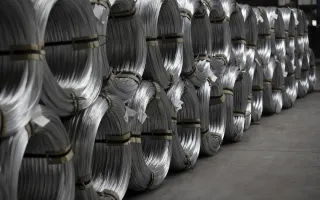
Coil weight and packing affect handling and how the load fits in a container. Carriers publish different payload limits for dry containers, so how many containers an order fills depends on the coil weight, the packing and the container booked. The container loading guide collects the figures. A quotation is written for a stated quantity, so give the tonnes for each diameter and finish, not one total for a mixed order.
What does each delivery term include?
The International Chamber of Commerce publishes eleven Incoterms rules, which clarify the tasks, costs and risks in delivering goods from seller to buyer. Wikipedia stresses what they leave out: they do not determine the amount payable, the currency or the credit terms. The table summarises the common rules for coils, as Wikipedia describes them.
| Rule | Seller covers | Buyer keeps |
|---|---|---|
| EXW | Makes the goods available | Risk and cost to the destination, export clearance |
| FCA | Export clearance, delivery to the named place | Carriage onward |
| CPT, CIP | Carriage to the destination; CIP adds insurance | Risk after the first carrier |
| FOB | Costs and risks until on board, export clearance | Sea freight, insurance, the rest |
| CFR, CIF | Freight to the named port; CIF adds insurance | Risk once on board, the rest after the port |
| DAP | Carriage to the destination | Unloading |
| DDP | Transport, export and import clearance, duties, taxes | Unloading; fewest obligations of any rule |
FOB, CFR and CIF are written for sea transport and suit non-containerized freight, per Wikipedia, so for containers ask your forwarder whether CPT, CIP or FCA fits better. Our UAE guide walks through the choice with a named port.
An EXW quotation and a DDP quotation are not the same offer, however alike the wire: the first leaves freight, insurance, clearance and duties to you.
What do freight, insurance, payment terms and currency change?
Marine insurance covers physical loss or damage to cargo in transit. Under CIF and CIP the seller must obtain it, while CFR and CPT leave it to you, so ask each offer who pays freight, who insures and up to which place.
Payment terms sit outside the Incoterms rules. Wikipedia describes a letter of credit as a payment mechanism in which a bank gives the exporter an undertaking to pay on presentation of documents. Whichever method you use, say so, name the currency and ask how long the quotation stays valid. Different currencies or payment terms make offers incomparable.
What can you send to get a quotation on one basis?
Copy the table into your request and fill in the second column.
| Field | What to write | Reinwent range |
|---|---|---|
| Finish | Galvanized or black annealed; annealed or as drawn | Both finishes |
| Diameter | mm per item, tolerance standard | 0.8 to 8 mm |
| Coating | Process, standard, g/m² figure | 50 to 300 g/m² |
| Temper | Temper or tensile band | Black annealed: 300 to 450 N/mm² |
| Coil and packing | Weight and packing you handle | Details field |
| Quantity | Tonnes per diameter and finish | Set per order |
| Delivery term | One Incoterms rule, named place or port | Any of the eleven |
| Freight, insurance | Who pays, who insures, to where | In the quotation |
| Payment | Method, currency, validity | In the quotation |
How does Reinwent quote steel wire?
Reinwent is a trading and sourcing company, not a manufacturer. For each order it collects offers from several suppliers among manufacturers in Türkiye, sets them on the basis you chose and keeps one point of contact with you until delivery. Some products are available from stock, and your quotation states what applies to your order. We publish no prices; we put offers on one basis, so you compare like with like.
Send the filled table through the quote form and you receive a quotation within 12 hours. Fuller field lists: the galvanized wire guide for importers, the binding wire guide and importing steel wire from Türkiye; how we work lists each step. When the fields are ready, request a quote.