 Steel
Key facts
- Tensile strength is the maximum stress a material withstands while being pulled before it breaks.
- For wire it is written in N/mm², which is numerically the same as MPa.
- ASTM A641 covers zinc-coated carbon steel wire in coils in soft, medium and hard temper, each with its own tensile band.
- Cold drawing raises the strength of steel wire and annealing softens it again.
- Hot-dip galvanizing is reported not to significantly change the mechanical properties of structural steel, and cold-worked steel shows small changes.
What the number means
Tensile strength is the maximum stress a material can withstand while it is stretched, before it breaks. A test pulls a sample until it fractures and the peak of the stress curve is the result. Stress is force per unit area, so the figure does not depend on how thick the wire is. For the full explanation of the test, see our guide to high tensile wire.
The unit is the point where listings go wrong. The SI unit is the pascal, and the megapascal is the usual multiple. One megapascal equals one newton per square millimetre, so N/mm² and MPa are the same number. A wire offered at 500 N/mm² is a 500 MPa wire. When a page shows 10 or 50 MPa for steel wire, a unit or a property has probably been mixed up. Steel is far stronger than that: structural steel is listed at 400 to 550 MPa.
What sets the strength of galvanized wire
- The base steel. Galvanized wire is carbon steel wire with a zinc layer. Mild steel has a relatively low tensile strength, and as carbon content rises the steel can be made harder and stronger but less ductile. The galvanized iron vs galvanized steel guide explains why the old name makes no difference.
- The temper. Temper is the strength level the wire is delivered at. Drawing wire through dies work hardens it, which raises strength and lowers ductility. Annealing reverses this, and an annealed wire is softer. Soft, medium and hard are the three tempers ASTM A641 names.
- The diameter. The standard prints different bands for different diameters, covered below.
Soft, medium and hard temper
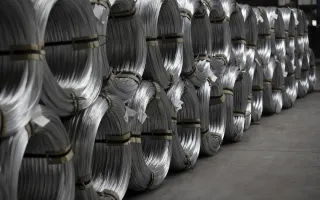
Soft galvanized wire is annealed, easy to bend and easy to knot. Hard wire is drawn to a higher strength and is stiffer. Medium sits between them. The practical rule is that the harder the temper, the higher the tensile band and the less the wire bends before it fights back.
In the soft vs hard question, tying and binding work favours the softer end, and jobs that need the wire to hold tension favour the harder end. Our guide to galvanized wire uses shows which jobs lean which way.
Tensile bands in ASTM A641
ASTM A641 covers soft, medium and hard temper zinc-coated carbon steel wire in coils for general use, and says the wire must meet the tensile requirements it sets. The SI table in the copy of the standard we read gives the bands below, in MPa, which equals N/mm².
| Wire diameter, mm | Soft | Medium | Hard |
|---|---|---|---|
| 0.20 to under 2.00 | 515 max | 485 to 690 | 620 to 825 |
| 2.00 to under 2.50 | 515 max | 485 to 655 | 585 to 795 |
| 2.50 to under 4.70 | 485 max | 450 to 620 | 550 to 760 |
| 4.70 and over | 485 max | 415 to 585 | 515 to 715 |
Two cautions apply. Soft wire has an upper limit only, with no minimum. And this is one edition of the standard, so the order must name the edition and the unit system, since the standard says inch-pound and SI values are not exact equivalents. The table helps you read offers; it is not a Reinwent specification.
Why diameter changes the band
The table shows the bands moving down as the wire gets thicker. Hard wire at the thin end runs from 620 to 825, and at the thick end from 515 to 715. The sources we read do not give a rule that explains the shift, and we do not offer one. The lesson is that a tensile figure means little without the diameter beside it.
Does the zinc add strength, or take it away?
The zinc layer does not add meaningful strength. Hot-dip galvanized material is described as combining the strength of steel with the corrosion resistance of zinc, and the strength is on the steel side of that sentence. The coating is a thin protective layer, and its mass in g/m² is a corrosion matter. Our guide to zinc coating classes covers it. EN 10244-2, the coating standard, specifies the requirement for coating mass, other properties and testing of the zinc coating, not tensile classes.
The process is a separate question. The American Galvanizers Association reports that hot-dip galvanizing does not affect tensile strength, proof strength, bend or impact properties of structural steels. For cold-worked steel the same body reports small changes in some mechanical properties, and larger bend radii lessened the effect. Drawn wire is cold worked, and the association is an industry body, so one source is not proof for wire. The simple precaution is to ask that the tensile result be measured on the finished galvanized wire.
How to write tensile strength in an enquiry
Put these items in the request, in this order:
- Diameter in mm, or a range with the quantity for each size.
- Tensile requirement: a band in N/mm² (minimum and maximum), or a temper name tied to a standard.
- Zinc coating: a class or a mass in g/m².
- Standard and edition, for example ASTM A641 or EN 10244-2 for the coating.
- Coil form and quantity, and the port of delivery.
- How the tensile will be checked: ask which test result will be supplied for the order.
Do not write only “high tensile” or “soft”: both words are relative. Our guide to types of galvanized wire lists the other choices in the order, and what GI wire is explains the name you will see most in listings.
Galvanized wire from Türkiye
Galvanized wire is made and exported in Türkiye, and Reinwent buys it from manufacturers in Türkiye. Reinwent is a trading and sourcing company and does not make wire. For each order we collect several offers and line them up on one basis, so the tensile bands can be compared like for like.
Reinwent supplies hot-dip galvanized wire in diameters from 0.8 to 8 mm, with a coating weight of 50 to 300 g/m², to EN 10244-2 and ASTM A641. The tensile band is set by the standard and by your order, so send it with the enquiry and it is confirmed in the quotation. See the process for galvanized wire from Türkiye, and use the wire gauge chart to turn a gauge into millimetres.
A quotation reaches you within 12 hours, and we keep you informed through the whole process. When your specification is ready, request a quote.