 Steel
Key facts
- Steel corrodes only where water and oxygen are present together, and salt speeds rusting up.
- A zinc coating protects steel as a barrier and corrodes first where the steel is exposed.
- Chain-link fence is usually woven from galvanized or polymer-coated steel wire.
- ASTM A641 covers galvanized carbon steel wire in coils for general use, in soft, medium and hard temper.
- ASTM A641 has a supplementary requirement for the coating on wire from which nails and staples are made.
Why buyers pick zinc-coated wire
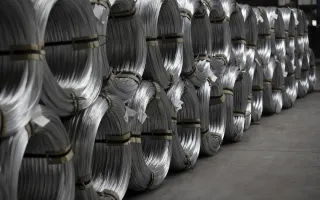
Every use of galvanized wire comes back to one property: the wire is expected to meet water. SteelConstruction.info states that corrosion of steel requires water and oxygen at the same time, and that without either one it does not occur. Wikipedia’s article on rust says the same of iron and adds that salt, for example in seawater or salt spray, makes it rust more quickly.
Galvanizing answers that problem in two ways. The zinc layer is a barrier between steel and atmosphere, and because zinc is more reactive than iron, it acts as a sacrificial anode at scratches, cut ends and gaps. Both Wikipedia and the American Galvanizers Association describe this barrier and sacrificial action. The zinc is used up as it works, and the Association states that coating service life is a linear function of coating thickness.
So the buyer’s real question is which diameter, how much zinc, which standard and which temper suit the place the wire ends up.
Uses at a glance, with what to specify
The table maps each end use to the order fields that matter. It does not prescribe a coating class for any use: the neutral sources we checked do not tie a coating figure to an application, so the figure stays the buyer’s decision, read from one standard.
| Use | What to specify | Where to read more |
|---|---|---|
| Tying and binding in construction | Diameter in mm, temper (soft for hand tying), coating mass in g/m² | Black annealed vs galvanized tie wire |
| Agriculture | Diameter in mm, coating mass in g/m², one standard | Zinc coating classes |
| Binding and bundling in industry | Diameter in mm, temper, coil weight and packing | Galvanized wire import order fields |
| Raw material for fence and mesh | Diameter in mm, coating class from one standard, temper | Hot-dip vs electro-galvanized wire |
| Raw material for nails and staples | Intended use stated in the order, coating to the nail and staple requirement of ASTM A641 | ASTM A641 coating classes |
Tying and binding on building sites
Tie wire holds parts together until they are fixed in place, and on an open site it may sit in rain or damp ground for a long time. That exposure is where the zinc earns its place.
For hand tying, softness matters as much as rust protection. ASTM A641 covers zinc-coated carbon steel wire in coils in soft, medium and hard temper, so a soft galvanized tie wire is an ordinary order, as long as the temper is written down. If the ties will be enclosed soon after tying and stay dry, black annealed wire is the usual alternative: annealing increases ductility and reduces hardness, but the wire carries no zinc. Our comparison of black annealed and galvanized tie wire sets the two finishes side by side.
Agriculture
Farm wire works outdoors, often in wet ground, and agriculture is one of the uses named on our product page. Because coating life follows zinc thickness, buyers for long outdoor service usually look first at the coating mass, then at the diameter that suits the job.
Both standards set their minimum zinc masses by diameter band, so a class is always read with a diameter. Our guide to zinc coating classes in EN 10244-2 and ASTM A641 shows each table on its own and explains why the letters of one standard do not translate into the other.
Binding and bundling in industry
Industrial users band coils, bundle bars and tubes, and close packs with wire. Here the order is often driven by handling: the diameter, the temper that suits the binding machine or the hand tool, and a coil weight and packing that fit the line. The full list of order fields, including packing and destination, is in our galvanized wire guide for importers.
Raw material for fence, mesh and nails
Wire is also bought to be turned into other wire products. Wikipedia’s article on wire names fencing, the wire netting industry, and nail making among the large consumers of wire. Two products tie that general statement to zinc-coated wire:
- Fence. Chain-link fencing is described as usually made from galvanized or polymer-coated steel wire, and in its making a metal wire, often galvanized to reduce corrosion, is woven on a rotating blade.
- Nails and staples. The most common nail is a wire nail. Galvanized nails are treated for resistance to corrosion and weather exposure, and ASTM A641 has a supplementary requirement that sets the zinc coating for nails, staples and the wire from which they are cut and formed. Its ordering information asks for the intended use when the wire goes to nails or staples.
Wire mesh, woven or welded, is used for guarding, vandal screens, baskets and animal cages. Galvanized wire is commonly used as the raw material for such wire products. Reinwent supplies the wire, not finished fence or mesh products.
The process can matter too: hot-dip galvanizing gives a thicker coating, electro-galvanizing a brighter finish. Our guide to hot-dip vs electro-galvanized wire explains the trade-off.
What every order should name, whatever the use
Whatever the end use, the same four fields make offers comparable:
- Diameter in millimetres. If a drawing gives a gauge number, convert it with our wire gauge chart first.
- Zinc coating mass in g/m², or a class from one standard. EN 10244-2 specifies coating mass, other properties and testing of zinc coatings on steel wire and wire products; ASTM A641 sets a minimum zinc mass for each class.
- The standard. Name EN 10244-2 or ASTM A641, not both, and take the class from that one.
- Temper. Soft, medium or hard, where ordering to ASTM A641.
If the name on your enquiry is GI wire, our explainer on what GI wire is confirms it is the same zinc-coated steel wire.
How Reinwent sources galvanized wire
Reinwent is a trading and sourcing company, not a manufacturer. Our hot-dip galvanized wire comes from manufacturers in Türkiye, in diameters from 0.8 to 8 mm, with a zinc coating of 50 to 300 g/m², to EN 10244-2 and ASTM A641. For each order we collect prices from many suppliers and put the offers on one basis. Some products are available from stock. We keep in continuous contact and manage the order from start to finish.
The page on galvanized wire from Türkiye explains how ordering works. When your use, diameter, coating, standard, temper and quantity are clear, request a quote and you receive a quotation within 12 hours.